MEVo
Maternity Equity through Voices
for champions (Healthcare Professionals within the Local Maternity System)
- Duration
- 6 Months
- JAN - JUN 2021
- Team
- Hyunjin Jo
- Geetika Kejriwal
- Soobin Song
- My Primary Role
- Design Research
- Qualitative Research
- Rapid Prototyping
- Methods
- Interview
- Field studies
- Participatory Design (co-create, co-operate, and co-design)
- Persona
- User Journey Map
- Prototyping
- Tools
- MURAL, Zoom
- Illustrator, Photoshop
- Premiere Pro, After Effects
The Challenge
Asian background mothers experience high birth deaths and they have lower rates of access to antenatal education. Pre-existing stereotypes and assumptions between South Asian mothers and midwives cause several blockers.
Project Brief:
How might we design systems to provide quality maternal healthcare for South Asian women in the UK
Opportunity:
We have identified key players within Local Maternity Systems, responsible for designing and delivering maternity services.
The Outcome
1. Our team created easy-to-follow, culturally sensitive guides tailored for local champions to facilitate workshops with South Asian mothers, ensuring a respectful approach at every stage.
2. We successfully introduced MEVo to key stakeholders at Sheffield Maternity Cooperative, collaborating closely on workshop implementation with carefully selected participants.
3. MEVo stands as a testament to collaborative creation, operation, and rigorous testing, now entrusted to the capable hands of local champions.
The Process

Discover
Based on the desk research we have identified:
1. Women from Asian backgrounds experience a two-fold difference in maternal mortality and almost 64% higher stillbirths and neonatal deaths as compared to white women, emphasising the need to address these disparities.
2. Antenatal education offered by the NHS, directly and indirectly, affects these outcomes as it helps mothers to prepare emotionally, mentally and physically.
3. South Asian women have lower rates of access to antenatal education leading to missed opportunities for preparation, lower rates of care satisfaction and unplanned births, increasing trauma, complications and in worse case scenarios mortality for mothers or babies.
Based on field research and interviews we have identified:
1. Low awareness and accessibility of services among South Asian mothers: this is because the social and healthcare system is different from their home country, and there are fewer competent channels or information touchpoints considered for them.
2. South Asian mothers, their families, and midwives may have built a kink relationship: they may have stereotypes and assumptions about each other based on previous experiences and knowledge that they have possessed historically from their communities.
3. South Asian mothers may show a lack of engagement toward their healthcare: as previously mentioned, due to prebuilt relationships with other key stakeholders, they may lose their trust and respect toward midwives (and vice versa) which may result in a lack of engagement.
Based on stakeholder interviews we have identified:
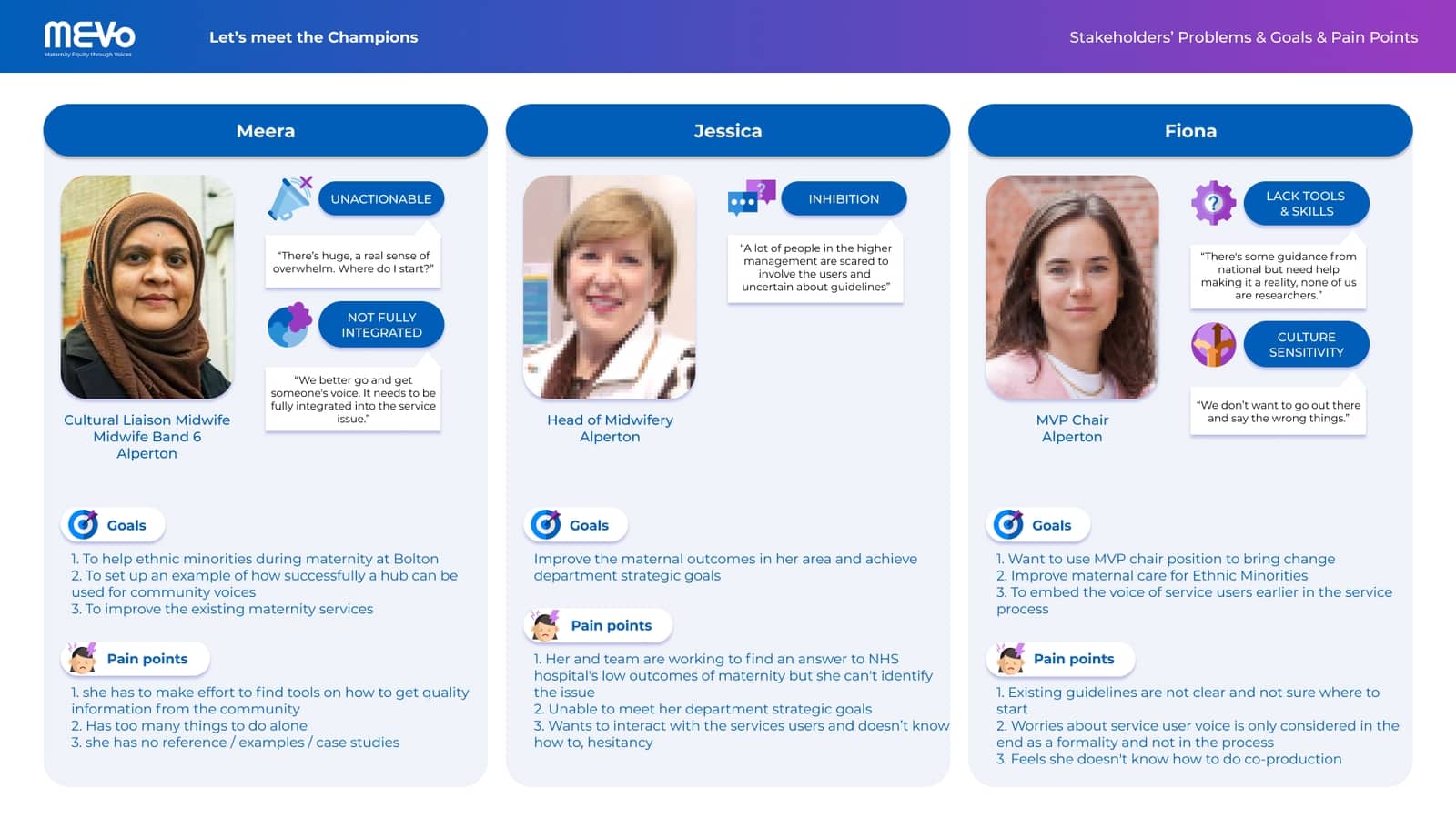
Within the Local Maternity Systems, which are responsible for the design and delivery of maternity services to the wider population, we identified key stakeholders who play a vital role in embedding our service user needs.
We see them as Champions.
Let's now meet the Champions and understand the barriers that they experienced in embedding the voices of our service users.
Meera, Cultural Liaison Midwife at Alperton, feels overwhelmed and doesn’t know where to start. She is also frustrated with service user voices being an afterthought and not fully integrated from the start.
Jessica, Head of Midwifery in Alperton, aims to complete the department’s strategic goals and improve the maternal outcomes. She feels that the higher management is often inhibited from involving the service users.
Fiona, local MVP Chair and does not have the skills and tools to conduct a co-production session with users while also being scared of cultural insensitivity when engaging with the users.
Define
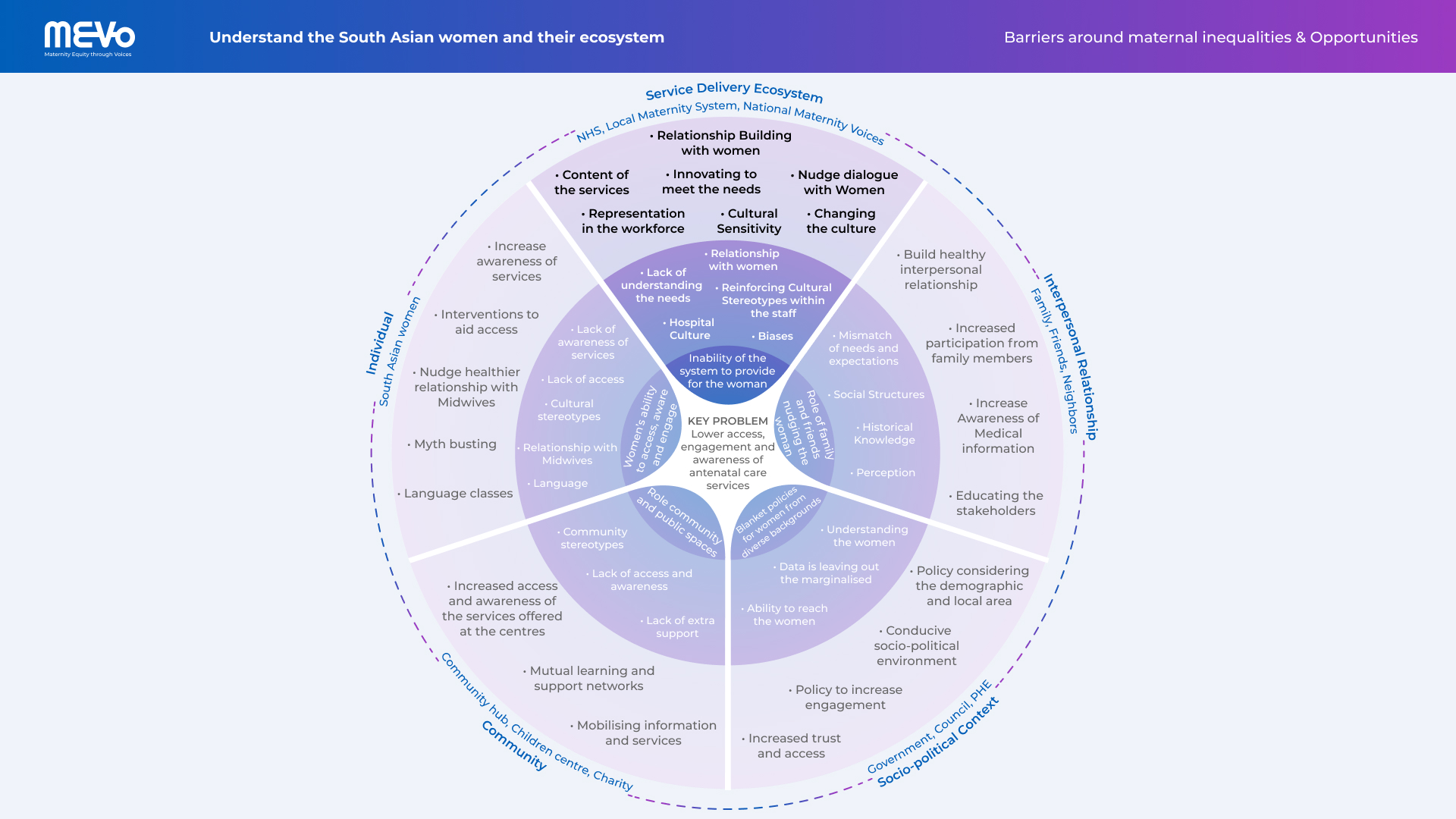
We analysed barriers to access across various dimensions, including individual capacities, interpersonal relationships, community dynamics, service delivery ecosystems, and socio-political contexts.
By contextualising South Asian women within their cultural framework, we identified a strategic entry point within the service delivery ecosystem. Our goal is to enhance care by developing and providing services that are not only accessible but also culturally relevant to the local context and the lived experiences of mothers.
Our Goals
1. Empower South Asian mothers to be aware of the services and their rights.
2. Build and maintain the trust and respect between the stakeholders.
3. Support South Asian mothers to be active participants in their own social and healthcare, especially in their maternity journey.
Develop
What is MEVo?
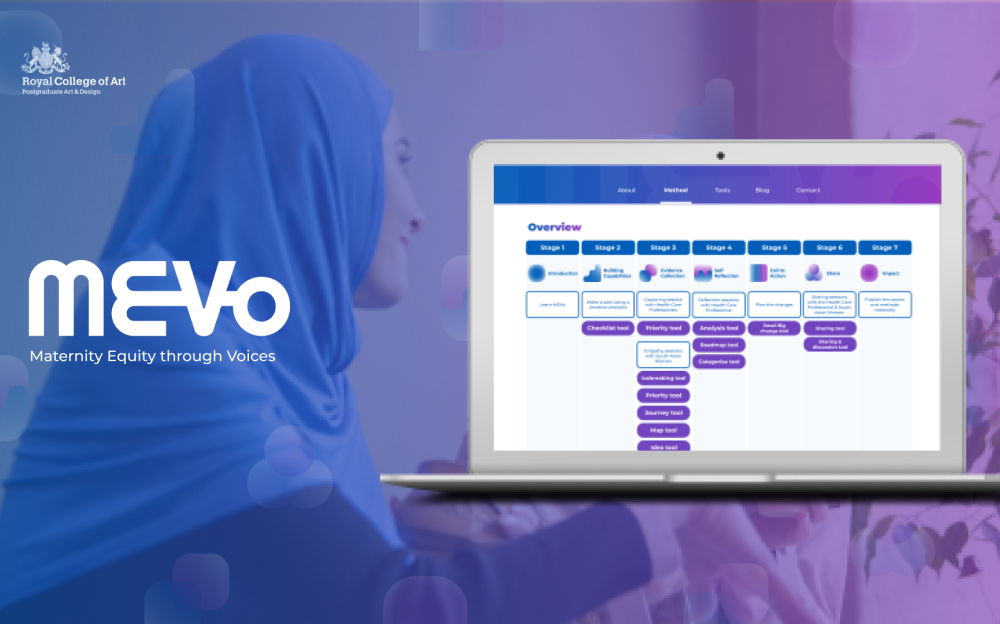
MEVo is a method for champions (Healthcare Professionals within the Local Maternity System) to facilitate dialogue among South Asian mothers to record, collect and embed the local voices of mothers in their transformation process, using a stage-based guided set of tools supported by the MEVo platform.
MEVo’s 7 stages include:
Stage 1. The objective is to introduce the method to champions through a website leveraging live examples and e-modules.
Stage 2. The objective is to build capabilities, planning, approvals and creating the network of HCP and South Asian mothers.
Stage 3. Provides tools to create dialogue between HCP and South Asian mothers to understand both sides of the story, record evidence and create ideas for plausible solutions.
Stage 4. Provides tools for self-reflection by the HCP to collate qualitative data and plan the changes that can deliver better care.
Stage 5. Focuses on addressing the changes using the recorded evidence to embed the voice of the users.
Stage 6. This is about sharing the changes with the HCP and mothers to build trust, responsibility and relations.
Stage 7. Focuses on creating a library of good practices that can inspire other champions across the UK.
Deliver
MEVo in Practise
In collaboration with local champion, Cultural Liaison Midwife at Bolton, we have tested MEVo and run virtual workshops with her and other South Asian mothers to understand the usability of tools for initiating dialogue, collecting evidence and analysing the data. Through the multiple sessions we were able to build and test the tools to fit within the seven stages of MEVo. Over the next few months we wish to run the pilot at Bolton BL3 hub, set up meetings with RCM and NMV for collaboration and reach out to more champions to endorse MEVo. Simultaneously, we will work on expanding the tools to cover more communities by adding relevant images, languages and scenarios. Finally, the aim is to build a library of good practices, which is the most important outcome for MEVo as it highlights what’s working and inspires more people.
Benefits & Impact of MEVo
Through MEVo, South Asian mothers can access a safe space to express their needs and opinions and in turn get the opportunity to access services that help them prepare better for their maternal journeys. Through tools of MEVo, Meera (our Champion) is able to understand the needs of the mothers and build a qualitative data set that can inform plans for the department. Over time MEVo enables building capacities to deliver user-centred care at a local level aided by evidence along the different timelines of the pregnancy journey. MEVo indirectly informs personal practice, cultural competency and highlights good practices within the department, giving insight into how to leverage that further.The NHS will be able to increase access to responsive care along with an increase in antenatal education attendance. In the long run MEVo aims to reduce insurance costs in maternity.
Are you interested in my project and want to know more?
Contact me!
guswls1994@gmail.com